4
min read
Just a few years ago, most accounting teams spent a significant part of their time dealing with repetitive document-related work. Invoices, contracts, approvals, data transfers between systems – all of it required constant manual effort and control.
Over the past few years, the situation has started to change noticeably.
Today, businesses expect much more from accounting teams than accurate reporting. Finance departments are increasingly involved in strategic decision-making, forecasting, risk assessment, and identifying growth opportunities. And one of the main reasons behind this shift is the automation of document workflows and the gradual elimination of operational routine.
Why the Traditional Approach No Longer Scales
In many companies, accounting still operates according to a model that has been built over the years: documents come from different sources, some processes happen through email, some through Excel or ERP systems, and certain tasks still live “in the memory” of individual people.
When the business is small, this can still work. But as the number of operations grows, manual processes begin to create delays.
We regularly see situations where the finance team spends more time searching for information and synchronizing data between systems than actually analyzing finances.
Instead of focusing on financial analytics, the team spends time on:
checking statuses;
copying data between systems;
manually approving documents;
fixing human errors;
searching for information across multiple platforms.
As a result, accounting gradually turns into an overloaded operational center with too much manual work passing through it.
That is why, in recent years, companies have been increasingly automating document flow and internal financial processes – not because of the “AI trend,” but because chaotic workflows simply cannot be scaled manually.
What Has Actually Changed
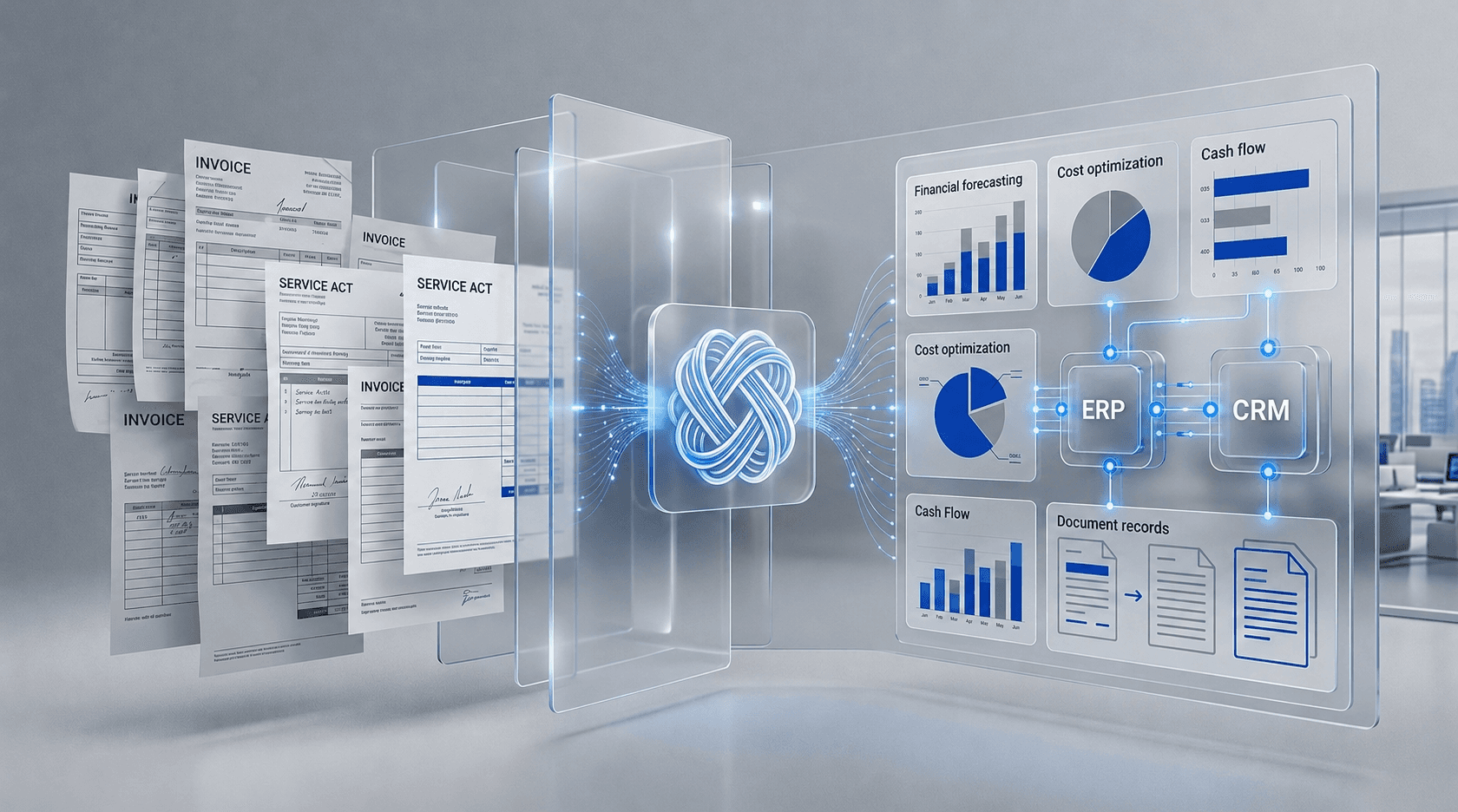
Automation has long moved beyond a simple “digital document archive.” Modern systems can independently recognize data from bills, launch approval processes, verify information, and synchronize data across several platforms at once.
What used to take hours can now often happen automatically in the background.
The development of AI solutions for document processing has had a particularly strong impact on this shift.
Today, companies are increasingly automating not just individual tasks, but entire workflows – from invoice processing to reporting and internal approvals.
Businesses are actively using tools that can:
analyze PDF files;
structure financial data;
generate reports automatically;
detect spending anomalies;
process invoices without manual input.
But the biggest change is not speed itself.
The real shift is that finance teams finally have time to focus on work that directly impacts business growth.
The Accountant’s Role Is Becoming Strategic
Until recently, accounting was often seen as a function that “supports operations.” Its main task was to process documents correctly and avoid mistakes.
Now this role is gradually changing.
When most routine processes are automated, the focus shifts from mechanical work to analysis and decision-making. Accountants begin to work more with:
financial forecasting;
cost optimization;
cash flow planning;
risk evaluation;
internal business analytics.
In many companies, it is now the finance team that helps management identify problem areas, evaluate process efficiency, and find opportunities for scaling.
In practice, the accountant is gradually becoming an internal financial advisor.
And this is one of the most important changes brought by automation.
Why AI Alone Does Not Solve the Problem
Over the past year, many companies have started actively implementing AI tools in financial processes. But it quickly became clear that if document flow inside the company is chaotic, automation does not deliver the expected results.
AI cannot work effectively when:
documents are scattered across different systems;
processes are not standardized;
information is duplicated;
critical workflows still depend on manual coordination.
That is why at Yarandin, we usually start not with “implementing AI,” but with analyzing how documents and data actually move inside the company. In many cases, the main problem is not the absence of AI, but overloaded and disconnected processes between teams and systems.
That is why the most successful companies begin not with “AI implementation,” but with building clear workflows. They centralize documents, integrate ERP and CRM systems, standardize processes – and only then add an AI layer of automation.
What This Means for Businesses in 2026
Today, accounting process automation is no longer just a way to “work faster.” For many companies, it has become a tool for scaling.
When the team stops spending time on routine tasks, the business can grow without constantly increasing the number of operational staff. At the same time, management gets:
better visibility into financial operations;
faster access to business data;
fewer operational mistakes;
more predictable workflows.
That is why the role of accounting in 2026 is becoming much more important than before.
Not because there are more documents.
But because modern business increasingly needs people who can not only keep records, but also help the company move strategically.
Routine work should not take up most of the finance team’s time.
At Yarandin, we help businesses automate document workflows, integrate ERP/CRM systems, and remove manual processes that create delays for financial and operational teams.
We have already seen how companies spend hours on invoices, approvals, and transferring data between systems – and how properly built automation can remove a significant part of this routine without creating chaos for the team.
If your team spends hours on invoices, approvals, data transfer, or working between several systems, it may be time to change that.