6
min read
More and more often, you can come across a discouraging statistic online: roughly 70% of digital transformation initiatives fail.
For a non-technical founder, CEO, or operations manager of a mid-sized company, this number sounds like a verdict. You invest time, money, and attention into new software — and still risk ending up with no result.
For small and medium-sized businesses, this misunderstanding is especially costly. A failed implementation doesn’t just waste money — it creates operational chaos, undermines employee trust, and often leaves the business in worse shape than before.
So a logical question arises:
Is it even worth starting a digital transformation at all?
To answer it, we first need to understand why those 70% fail in the first place.

Why the “70% failure rate” is not about technology
The well-known 70% figure, popularized by research from firms like McKinsey and Boston Consulting Group, is often misinterpreted.
Many business owners assume it means: “the software doesn’t work.”
In reality, it means the business did not achieve the expected return on investment (ROI).
Most mistakes happen at the decision-making stage, long before the first line of code is written or the first subscription is purchased.
Most commonly, the reasons look like this:
unclear business goals
weak decision-making
lack of accountability
internal resistance to change
absence of measurable outcomes
In other words, the technology usually works. The organization around it does not.
Digital transformation fails when companies expect tools to solve problems they themselves have not clearly defined.
The most common digital transformation mistakes
1. Automating chaos without structuring it
A common mistake in business process automation is trying to automate chaos without understanding how it actually works.
In most SMBs, processes are undocumented: decisions are made intuitively, responsibility is blurred, and actions depend on specific people. This is a normal state for a growing business.
The problem appears when this chaos is immediately “hard-coded” into a system. In that case, automation doesn’t create order — it simply locks the disorder in place.
2. Buying tools without a clear business goal
Many founders fall into this trap.
They buy a tool because someone somewhere said or wrote that it’s a great and effective solution.
If you can’t clearly describe in one sentence the specific business problem this tool is supposed to solve, you’re not ready for it.
3. Treating digital transformation as a one-time project
Many SMBs approach digital transformation like a renovation: you do it once and forget about it.
But business constantly changes: volumes grow, markets shift, new requirements appear. A system built once and never revisited gradually becomes outdated.
4. Expecting software to replace management
Some business owners hope that implementing new systems will somehow fix basic management issues: unclear responsibilities, poor communication, or lack of execution.
It won’t.
These are management problems, not technological gaps.
5. Ignoring the team during change
A large share of digital transformation failures is directly tied to people not accepting new systems. Because they weren’t consulted, weren’t trained, and don’t understand how or why things are changing.
When a sales manager continues to track clients in a notebook because the CRM feels like “complicated reporting for the boss,” that is the exact moment transformation fails.
Why SMBs are more vulnerable than large enterprises
While small and medium-sized businesses are far more flexible, large companies can afford mistakes — SMBs usually cannot.
There are three key reasons:
Limited resources: no budget for years-long experiments
No time buffer: productivity drops are felt immediately
Vendor dependence: external tools and consultants often dictate decisions
When a digital initiative fails in an SMB, it hits finances, the team, and leadership focus all at once.
What does a successful transformation approach look like?
The 30% of companies that succeed don’t necessarily have more money — they have more discipline.
They start with processes, not tools.
Before looking for software, they analyze the entire workflow, identify exactly where the problem is, and only then look for a tool that closes that specific gap.
They build systems step by step.
Instead of a massive launch where everything changes on Monday morning, they implement one module at a time. This limits risk and allows teams to gradually build confidence and competence.
They measure outcomes, not features.
Success is not “we now have 10 new features in the CRM.”
Success is “customer response time dropped from 24 hours to 2 hours.”
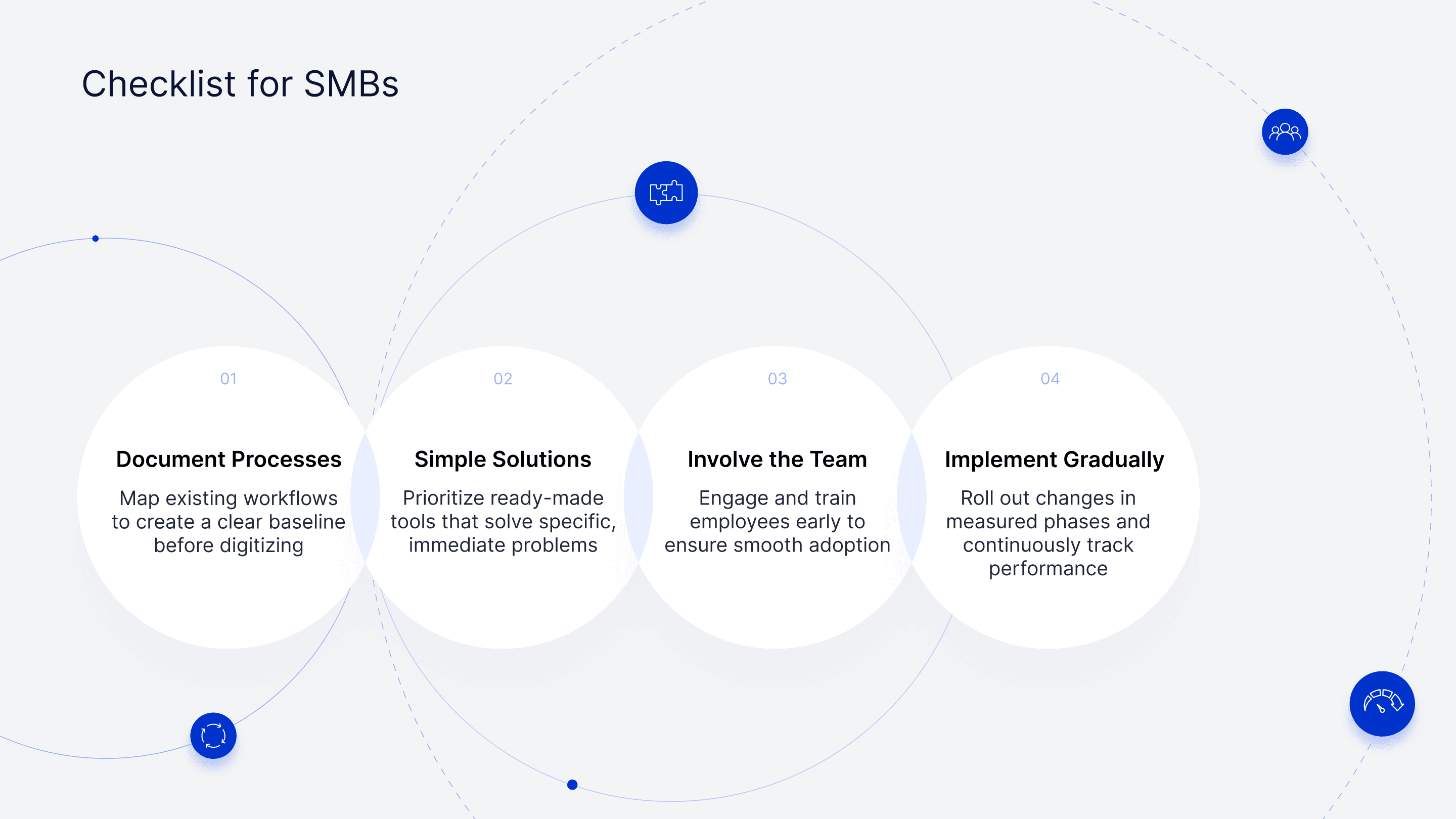
Checklist for SMBs
Document your current process and create artifacts at each stage: who does what, in what sequence, and with what outcome.
Choose the simplest solution for a specific task. Use off-the-shelf products that already exist if they meet your need.
Involve the team from the very beginning. Train them to work with new tools and support the digital environment.
Implement gradually and continuously measure results.
Conclusion: implementation discipline, not technical upgrades
Digital transformation is not something you buy; it’s something you do. It is a management discipline that uses technology to deliver better value to customers and maintain calm within the team.
Those 70% of companies fail because they try to use technology to avoid the hard work of managing information. To avoid their fate, stop viewing software as a magic wand. Treat it as a tool — like a hammer or a truck — effective only to the extent that the person using it is effective, and the plan they follow is sound.
Don’t be afraid to start.
Digital transformation doesn’t require a perfect plan, large budgets, or instant change. It begins with one process, one clear decision, and the willingness to look honestly at your business.
Step by step, with measurable results and an engaged team, digital change stops being a risk — and becomes a growth tool.
The alternative — leaving everything as it is — usually costs far more.